My exhibition date is fast approaching. In a month’s time I will have my first solo museum show in Limerick. It has been a fantastic time of research and creative development and hard work. It is almost a full year since I was invited to select an artefact from the Limerick City Museum collection and respond to it with a body of ceramic work for exhibition. Yesterday I began packing some of the twenty plus ceramic pieces that I have made in the intervening period and it is a good feeling to be at this stage.
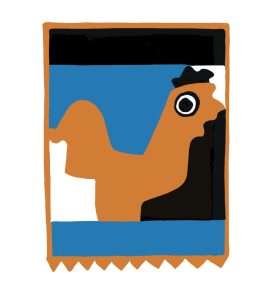
So how, you may well ask, did it all progress? My starting point was the little bronze spigot and I’ve spoken about this in an earlier post. I took my time to examine it very carefully. I tried to understand what it is about this artefact that drew me to it so strongly. I am attracted to the familiarity and domesticity of the subject of the hen. Its diminutive scale is another factor, it is so tiny that it is not possible to discern what it is until you are very close. I like the fact that it has a function and yet it rises far above the mere functional. Perhaps there something intrinsically feminine about it – could it have been made by a woman? Perhaps it was a gift for a spouse or a daughter? There is something intimate about this tiny object that brings this to mind. The person who made it has imbued in it a sensitivity that is palpable and a character that is absolutely joyful.

The little hen spigot
I looked very closely at the design – the outline contains an energy that reminds me of an expressive drawing, it is a swish of confident curves and lines. I think that the maker almost certainly drew the design before making it in bronze. The eye is made from two imperfect circles that are bigger in scale than they would be in life. I love this feature because the creature seems to hold your gaze and it has a timelessness – it might have been made today and not five hundred years ago.
I started the process by bringing some of this information – the outsized eye, the confident curves and the imperfect circles – to my drawings which I made on the design app ‘Procreate.’ I enjoy using this app because it feels effortless – the ipencil mimics a real pencil and you can insert and swap blocks of colour quickly.
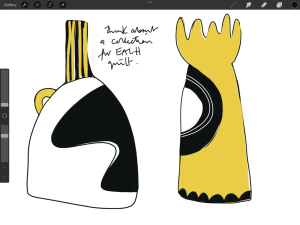
Some designs made on the ‘Procreate’ app
I chose a conical form to begin the clay work. The beauty of a cone is that it can be inverted and used upside down as well as right side up to make different but relatable forms. This cone shape forms the basis of many of the final pieces. I construct the shapes in cardboard before I start making in clay and this acts as a transition between two and three dimensions. Once I find something that works, I use the cardboard ‘templates’ as patterns to cut out the clay pieces. This process is called ‘slab building’ – you start by rolling out an even slab of clay and you cut out the shapes required to build the form. The slabs are allowed to dry a little before being assembled using ‘slip’ or liquid clay as a kind of glue. Once the basic structure is made, I work without too much of a plan to allow the form to evolve. I bought a slab roller after a couple of months of rolling by hand and this allowed me to work much more easily and quickly. I love marking the clay from the inside to capture the plasticity of the material and to produce an interesting surface texture.
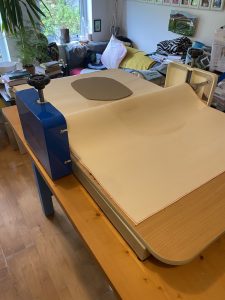
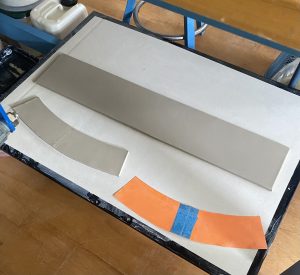
A new slab roller and some cut out slabs
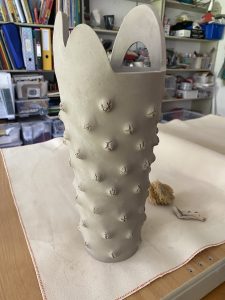
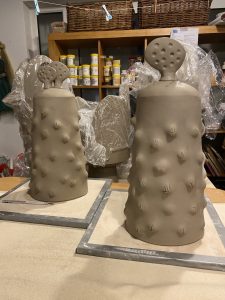
Conical forms that have been marked from the inside
Once I was immersed in making, the next idea was often dictated by the last. So I would create a form and think, ‘I wonder if this would work upside down or with different additions to the top or sides ..’ and then I’d try that and yet another version would suggest itself. After a while of working in this way, I knew that I needed a show piece, something larger that would demand attention. I decided to move away from the vessel and towards something more free and sculptural. This was exciting new territory for me. I started by making a large slab built cone that I distorted from the inside with a bulbous tool. This amorphous shape emerged which I sealed over at the top. I wanted to give it a crown of sorts but I was restricted with height because of the height of my kiln. I settled on a little copse of abstract trees. Trees are a theme that recur in my work and they signify to me the presence of nature as a comforting presence. While the hen spigot was foremost in my mind, my own stories emerged during the creative process and sometimes they took over. I think that everything we do and see and learn finds its way into the things that we make, either consciously or unconsciously.
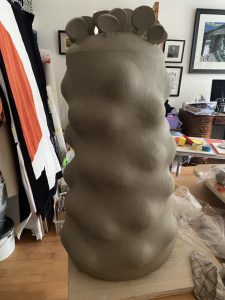
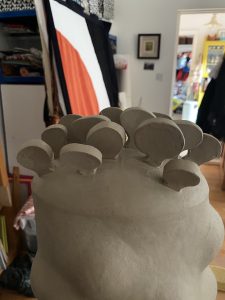
The first large sculptural form
As time went on another chalice like form suggested itself to me and I pursued that for a while. Then I made a second large sculptural piece in two sections which eliminated the height problem. I worked long into the summer making and drying and firing these objects before I could start to think about colour and glazing and the crucial second firing.
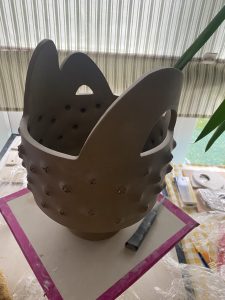
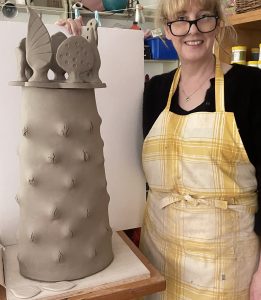
A chalice form and a second tall sculptural piece
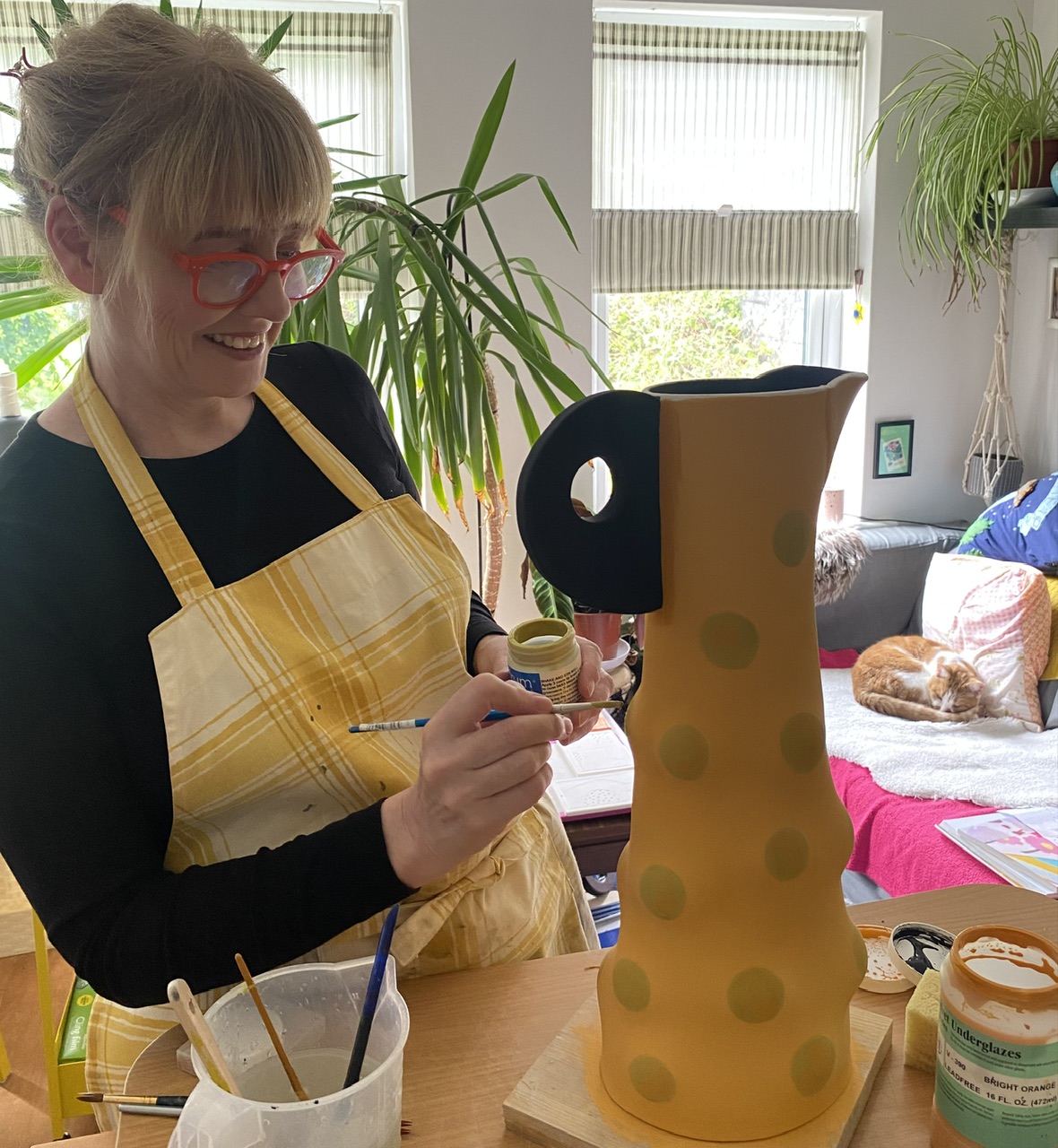
Ceramics is a long and drawn out process and it takes months to complete a series of work. By late August I was finally ready to start glazing. I used bold underglaze colours which I applied in multiple layers to get an even finish. I allowed these to dry completely before applying a transparent glaze over the top. This layer appears white as it goes into the kiln for the second time – the colour emerges during the second firing as the glaze becomes transparent.
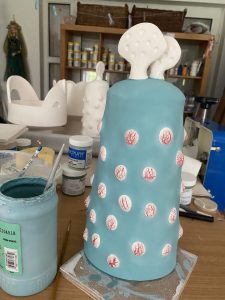
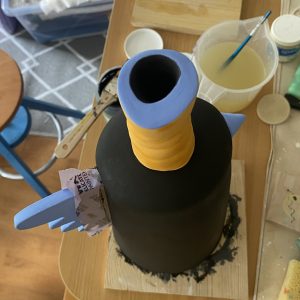
Applying the underglaze colour
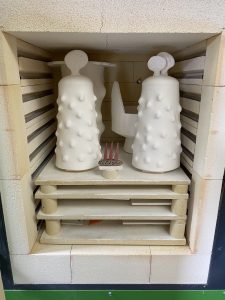
Pieces coated with transparent glaze and ready to fire
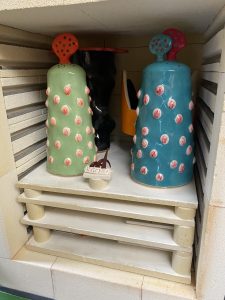
The underglaze colour as it appears once the second firing is complete
I feel a mixture of high spirits and relief as the opening date draws near. I still have to transport the ceramics safely to Limerick and display them in an interesting way. I will have the help of art curator Maurice Quillinan which I will need because this is just as important as all the other processes. This evening I have been designing posters and newsletters with the help of my daughter. I am updating my website so that visitors can link to it for more information and I’m learning about QR codes. I hope that the end of this long and exhaustive process finds more beginnings and I am so grateful to have had this opportunity to progress my work and to participate in such an engaging and exciting project.