I have just returned from a whirlwind four day trip to New York City with Gavin Lavelle and my artist friend and cousin Lorna Watkins. We stayed with family and friends in the distinctive brownstone Brooklyn neighbourhood. April might just be the perfect time to visit, as the sun shone brightly every day and the streets and parks were festooned with pink and white apple blossom and magnolia. People chatted to us everywhere we went – about the weather, about where we are from and about their dogs ( so many dogs ) always obedient and seemingly streetwise.
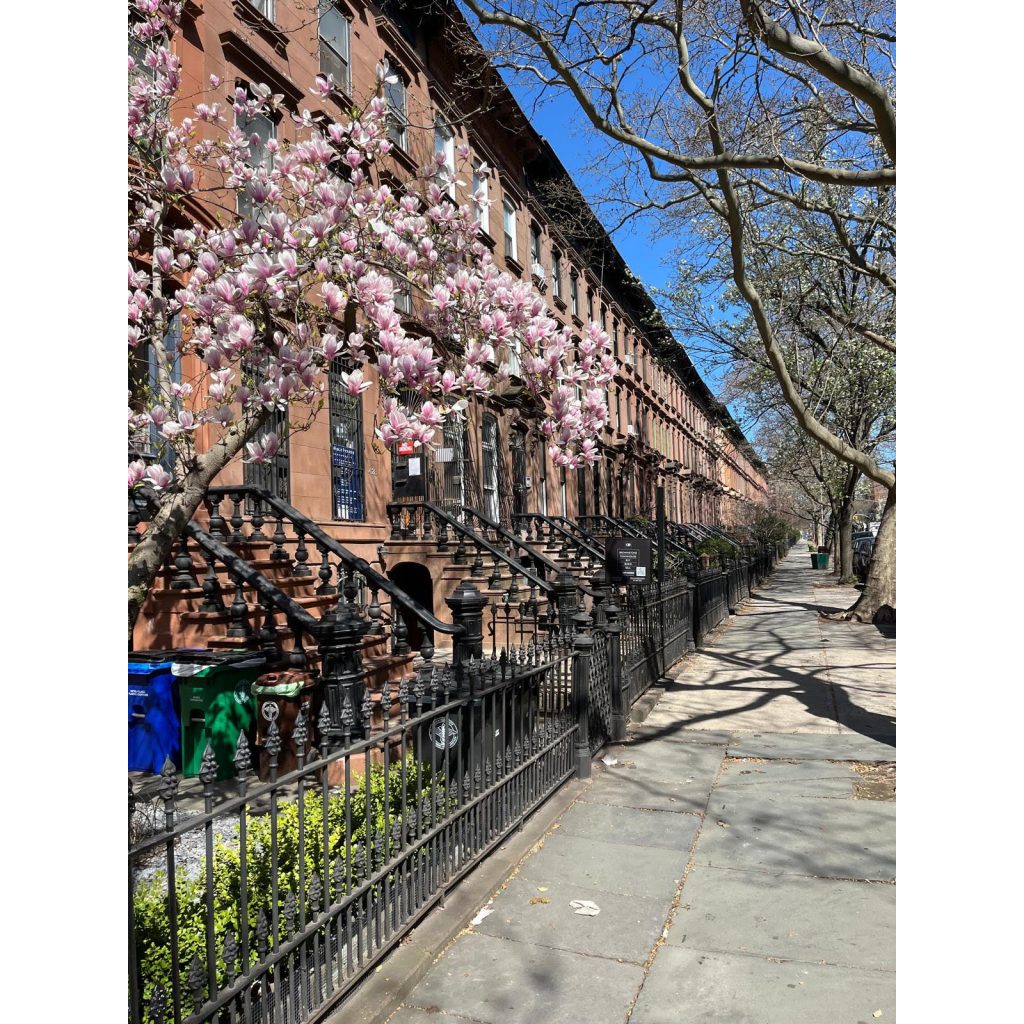
Magnolia trees in bloom on a Brooklyn Street
We saw as many friends and as much art as we could physically manage on a short trip. I start this blog with a piece about an exhibition we visited on our first day. Perhaps I will return to more later – at present it is my aim to write at least one post per month about my work and about the things that become part of the store of visual language that I draw from in my own practice.
This exhibition is running in the American Folk Art Museum on Lincoln Square in New York. I discovered it through the Bloomberg Connects app, which is a digital guide to hundreds of arts and cultural organisations around the world. At the time of our visit, the app linked to the museum’s current show titled ‘Madalena Santos Reinbolt: A Head full of Planets.’ I was immediately drawn to the colourful and richly textured images of her work.
The museum building is easy to find and easy to navigate as it contains just a handful of rooms as well as a seductively colourful and well stocked shop at the entrance. Information panels explain that this is the first solo exhibition in the United States devoted to Madalena Santos Reinbolt (1912-1976, Petropolis, Brazil. ) There are forty two of her paintings and ‘wool paintings,’ a term the artist uses to describe her tapestries made on burlap with heavy weight wool. Madalena began painting while she worked as a live-in cook for the architect Lota de Macedo Soares and her partner Elizabeth Bishop, the American poet. In the mid 1960’s she shifted her focus to working with textiles.
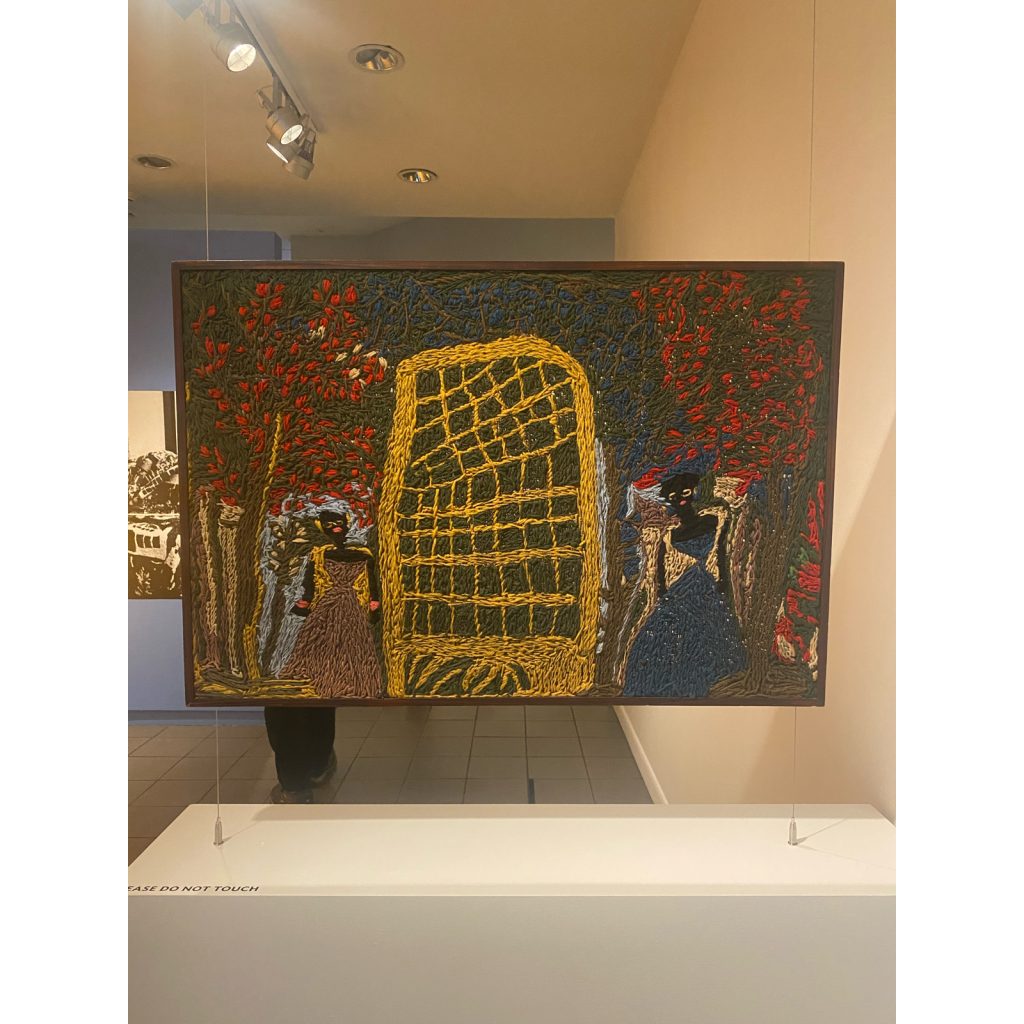
Untitled textile painting in wool and burlap by Madalena Santos Reinbolt
The title of the exhibition ‘A Head full of Planets’ derives from interviews given by the artist with art critic and historian Lelia Coelho Frota, who went on to include her work in the Brazilian pavilion of the 1978 Venice Biennale. The expression in Portuguese ‘uma cabeca cheia de planetas’ can be translated as a kind of multi faceted knowledge. It also alludes to the importance of the rich inner world of this artist in contrast to the restrictive reality of her working life in a time of class and gender inequity.
I was immediately struck by the scale of the materials in these works. Unlike traditional tapestries or embroideries, she used heavy weight wool instead of thread. The free flowing stitches resemble the gestural brush strokes made by Vincent Van Gogh a hundred years earlier in Europe. There is something about the movement of the stitches that strongly suggest the expressive use of paint. Madalena herself referred to these works as ‘textile paintings.’ The surfaces bulge out in areas where the stitches have been laid down close together and where especially thick wool was used. This creates an undulating effect that adds to the drama. It is suggested that she may have chosen tapestry because of an allergic reaction either to paint or to the soap she used to clean her hands after painting. Clearly it was a move that suited her and she took to the craft with free reign, reimagining tradition in order to bring a fluidity and energy to her imagery.
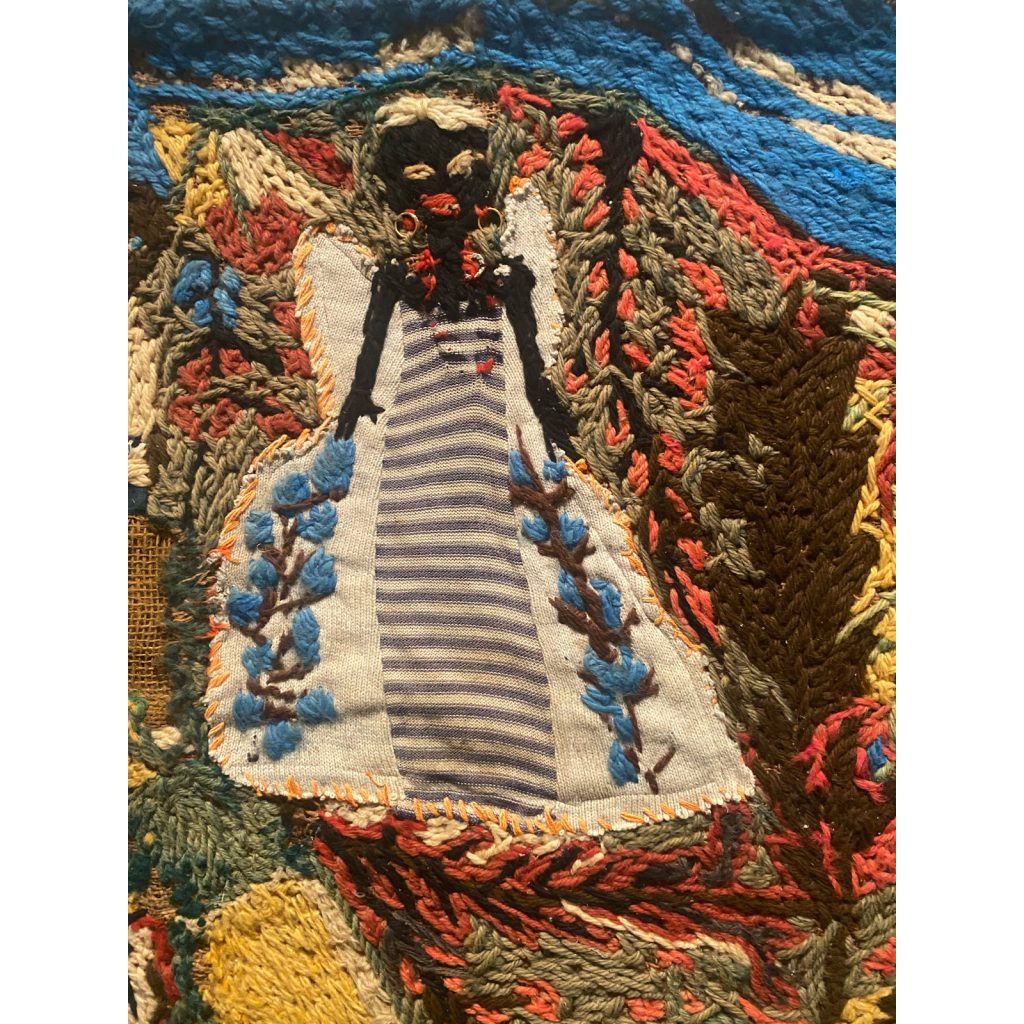
Detail of a female figure in a wool painting by MSR
Before starting a tapestry, Madalena would thread up to 150 needles with different colours of wool so that they were ready to go like paint on a painter’s palette. Describing her process, Madalena said, ‘I never traced anything out.. I do things in my head.’ She chose burlap as a ground over regular fabric because the thick uneven material was readily available and its coarseness allowed her greater freedom and expressiveness.
I work everything out in my head.
I can see it all even with my eyes closed….
Really, it’s the needles that are doing the drawing.
For example, I’ll do everything in black,
then I’ll want to do it all in blue, so I’ll grab my blue needles,
or I’ll want to use yellow, so I grab the yellow threaded needles,
and I’ll stitch away until I end up with this colourful thing.
( extract from ‘A Head full of Planets‘ )
Madalena’s work includes figures and landscapes in a simplified style that we might recognise as ‘folk art’ or art which is self-taught and free from the confines of traditional teaching. This style became popular in Brazil during the modernist movement, which cultivated an appreciation for art and craft that was deemed to be authentic. Consequently, it was seen to have much to offer the world as untainted expressions of national identity. Religion and spirituality are big themes across her work, but it is the materials that make them so appealing in my view. You want to run a hand over the uneven surfaces and trace her lines of stitching as she made them, imagining the calmness or in another corner, the flurry in which they were made. These works are imbued with the energy of their maker unlike traditional tapestry, where perfection and evenness champion personal expression. Madalena’s vitality is present in every fibre and her life force is as evident today as the moment that she brought them into being.